What Was the Reaction to the Bosnian Genocide by the Outside World While It Was Occurring
| Bosnian genocide | |
|---|---|
| Part of the Ethnic cleansing in the Bosnian War | |
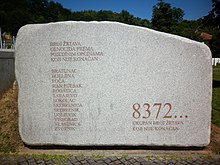 Memorial stone at the Srebrenica-Potočari Memorial Middle | |
| Location | Bosnia and Herzegovina |
| Date | 11–xiii July 1995 (1995-07-13) |
| Target | Bosniak (Bosnian Muslim) men and prisoners of state of war[1] |
| Set on blazon | Mass murder, persecution, ethnic cleansing, deportation, etc. |
| Deaths | Genocide:[a]
|
| Perpetrators | Ground forces of Republika Srpska (VRS),[2] Scorpions paramilitary grouping[five] |
| Motive | Anti-Muslim sentiment, Greater Serbia, Serbianisation |
The Bosnian genocide (Bosnian: bosanski genocid) refers to either the Srebrenica massacre or the wider crimes against humanity and ethnic cleansing campaign throughout areas controlled past the Army of Republika Srpska (VRS)[6] during the Bosnian War of 1992–1995.[7] The events in Srebrenica in 1995 included the killing of more than 8,000 Bosniak (Bosnian Muslim) men and boys, as well as the mass expulsion of another 25,000–xxx,000 Bosniak civilians by VRS units under the command of General Ratko Mladić.[8] [9]
The ethnic cleansing that took place in VRS-controlled areas targeted Bosniaks and Bosnian Croats. The ethnic cleansing campaign included extermination, unlawful confinement, mass rape, sexual set on, torture, plunder and destruction of private and public property, and inhumane treatment of civilians; the targeting of political leaders, intellectuals, and professionals; the unlawful deportation and transfer of civilians; the unlawful shelling of civilians; the unlawful cribbing and plunder of real and personal belongings; the destruction of homes and businesses; and the destruction of places of worship. The acts accept been found to take satisfied the requirements for "guilty acts" of genocide, and that, "some physical perpetrators held the intent to physically destroy the protected groups of Bosnian Muslims and Croats".[10]
In the 1990s, several regime asserted that ethnic cleansing as carried out past elements of the Bosnian Serb army was genocide.[11] These included a resolution by the United nations Full general Associates and iii convictions for genocide in German language courts (the convictions were based upon a wider interpretation of genocide than that used past international courts).[12] In 2005, the United states Congress passed a resolution declaring that the Serbian policies of aggression and ethnic cleansing meet the terms defining genocide.[13]
The Srebrenica massacre was found to be an act of genocide by the International Criminal Tribunal for the Former Yugoslavia, a finding upheld by the ICJ.[14] On 24 March 2016, one-time Bosnian Serb leader and the first president of the Republika Srpska, Radovan Karadžić, was institute guilty of genocide in Srebrenica, state of war crimes, and crimes against humanity and sentenced to 40 years in prison. In 2019 an appeals court increased his sentence to life imprisonment.[15] On 12 May 2021 it was announced that, with the understanding of the U.k. government, he would serve the balance of his judgement in a UK prison house.[xvi]
Un
| External video | |
|---|---|
 Everyday objects, tragic histories Ziyah Gafić, TED Talks, March 2014, 4:32[17] Everyday objects, tragic histories Ziyah Gafić, TED Talks, March 2014, 4:32[17] |
On 18 December 1992, the U.N. General Associates resolution 47/121 in its preamble deemed ethnic cleansing to exist a course of genocide stating:[xviii] [19]
Gravely concerned well-nigh the deterioration of the state of affairs in the Republic of Republic of bosnia and herzegovina owing to intensified aggressive acts past the Serbian and Montenegrin forces to larn more territories past force, characterized past a consistent pattern of gross and systematic violations of human being rights, a burgeoning refugee population resulting from mass expulsions of defenceless civilians from their homes and the existence in Serbian and Montenegrin controlled areas of concentration camps and detention centres, in pursuit of the abhorrent policy of "ethnic cleansing", which is a form of genocide...
On 12 July 2007, in its judgement on the Jorgić v. Deutschland case, the European Court of Man Rights noted that:[twenty]
the ICTY, in its judgments in the cases of Prosecutor five. Krstić and Prosecutor five. Kupreškić, expressly disagreed with the wide estimation of the 'intent to destroy' every bit adopted past the Un General Associates and the German courts. Referring to the principle of nullum crimen sine lege, the ICTY considered that genocide, every bit defined in public international police force, comprised only acts aimed at the physical or biological devastation of a protected group.
International Criminal Tribunal for the Old Yugoslavia
Finding of genocide at Srebrenica

Exhumation of the Srebrenica massacre victims
In 2001, the International Criminal Tribunal for the Former Yugoslavia (ICTY) judged that the 1995 Srebrenica massacre was genocide.[21] In the unanimous ruling Prosecutor v. Krstić, the Appeals Bedroom of the International Criminal Tribunal for the former Yugoslavia (ICTY), located in The Hague, reaffirmed that the Srebrenica massacre was genocide,[22] the Presiding Judge Theodor Meron stating:
By seeking to eliminate a part of the Bosnian Muslims, the Bosnian Serb forces committed genocide. They targeted for extinction the forty g Bosnian Muslims living in Srebrenica, a grouping which was emblematic of the Bosnian Muslims in general. They stripped all the male person Muslim prisoners, military and civilian, elderly and young, of their personal belongings and identification, and deliberately and methodically killed them solely on the basis of their identity.[23]
In September 2006, onetime Bosnian Serb leader Momcilo Krajišnik was found guilty of multiple instances of crimes confronting humanity, only while the ICTY judges found that in that location was prove that crimes committed in Bosnia constituted the criminal deed of genocide (actus reus), they did not establish that the defendant possessed genocidal intent, or was part of a criminal enterprise that had such an intent (mens rea).[24]
In 2007, the court found bereft evidence to conclude on alleged genocidal intent.[25]
The Court is however not convinced, on the basis of the evidence before it, that it has been conclusively established that the massive killings of members of the protected group were committed with the specific intent (dolus specialis) on the part of the perpetrators to destroy, in whole or in part, the grouping as such. The killings outlined above may corporeality to war crimes and crimes against humanity, simply the Court has no jurisdiction to decide whether this is then.
Finding of genocide at Žepa
In the case of Tolimir, in the starting time caste verdict, the International Criminal Tribunal has ended that genocide was committed in the enclave of Žepa, outside of Srebrenica.[26] However, that confidence was overturned by the appeals sleeping accommodation, which narrowed the crime of genocide only to Srebrenica.[27]
Milošević trial
On 16 June 2004, in Prosecutor v. Slobodan Milošević: Determination on Motion for Sentence of Acquittal, the ICTY Trial Bedroom refused to acquit one-time Serbian president Slobodan Milošević on the same grounds, and ruled:
246. On the basis of the inference that may exist drawn from this show, a Trial Chamber could be satisfied beyond reasonable dubiousness that at that place existed a articulation criminal enterprise, which included members of the Bosnian Serb leadership, whose aim and intention was to destroy a part of the Bosnian Muslim population, and that genocide was in fact committed in Brčko, Prijedor, Sanski Well-nigh, Srebrenica, Bijeljina, Ključ and Bosanski Novi. The genocidal intent of the Bosnian Serb leadership can exist inferred from all the evidence, including the prove set out in paragraphs 238–245. The scale and pattern of the attacks, their intensity, the substantial number of Muslims killed in the seven municipalities, the detention of Muslims, their brutal treatment in detention centres and elsewhere, and the targeting of persons essential to the survival of the Muslims as a group are all factors that signal to genocide.[28]
On 26 Feb 2007, still, in the Bosnian genocide instance, the United Nations International Court of Justice (ICJ) institute that there was no prove linking Serbia nether the dominion of Milošević to genocide committed by Bosnian Serbs in the Bosnian War. Nonetheless, the court did observe that Milošević and others in Serbia did non exercise enough to forbid acts of genocide from occurring in Srebrenica.[29]
On 22 November 2017, an International courtroom in The Hague institute Full general Ratko Mladić guilty of one count of genocide, 5 counts of crimes against humanity and iv counts of violations of the laws or customs of war. He was found not guilty of i count of genocide and sentenced to life imprisonment.[xxx]
Bosnian Genocide Trial
Currently, former Bosnian Serb leaders Radovan Karadžić and Ratko Mladić were both on trial on 2 counts of genocide and other war crimes committed in Srebrenica, Prijedor, Ključ, and other municipalities of Bosnia. Karadžić and Mladić are charged, separately, with:
Count 1: Genocide.
- Municipalities: Bratunac, Foča, Ključ, Kotor Varoš, Prijedor, Sanski Most, Vlasenica and Zvornik. Initially dismissed by the Trial Chamber on 28 June 2012,[31] this count was unanimously reinstated on 11 July 2013 by the Appeals Sleeping accommodation. The Appeals Bedchamber concluded, inter alia, that the Trial Chamber erred past finding that evidence adduced by the Prosecution was incapable of proving certain types of genocidal acts equally well as relevant genocidal intent by Karadžić.[32]
Count ii: Genocide.
- Municipality: Srebrenica.
Count 3: Persecutions on Political, Racial and Religious Grounds, a Law-breaking Against Humanity.
- Municipalities: Banja Luka, Bijeljina, Bosanska Krupa, Bosanski Novi, Bratunac, Brčko, Foča, Hadžići, Ilidža, Kalinovik, Ključ, Kotor Varoš, Novi Grad, Novo Sarajevo, Stake, Prijedor, Rogatica, Sanski About, Sokolac, Trnovo, Vlasenica, Vogošća, Zvornik and Srebrenica.
They are also charged with murder, deportation, inhumane acts, spreading terror among civilians, unlawful attacks on civilians, and taking of hostages.[33] [34]
Interest of Serbia
The UN's highest court has cleared Serbia of directly responsibility for genocide during the 1990s Bosnian state of war. Merely the International Court of Justice did rule that Belgrade had violated international law past failing to forbid the 1995 massacre at Srebrenica.[35]
On 28 February 2013, the ICTY Courtroom of Appeals overturned a conviction for JNA (Yugoslav National Army) Chief of Staff Momčilo Perišić for crimes committed in Bosnia and herzegovina and Croatia and ordered Perišić's immediate release.[36] His acquittal means that, to date, no official or regular army officer of Serbia-Montenegro (Yugoslavia) and no fellow member of the JNA or VJ high command has ever been convicted by the ICTY for state of war-crimes committed in Bosnia.[37]
On xxx May 2013, the ICTY acquitted and ordered the firsthand release of Jovica Stanišić and Franko Simatović, two close aides of Slobodan Milošević. Stanišić was the Chief of the Serbian State Security Service, while Simatović was in charge of the special operations arm of the Land Security Service.[38]
U.s.a. House and Senate resolutions
The month before the 10th ceremony of the Srebrenica Massacre, both houses of the Us Congress passed similarly worded resolutions asserting that the policies of aggression and ethnic cleansing as implemented by Serb forces in Republic of bosnia and herzegovina from 1992 to 1995, including the Srebrenica Massacre, constituted genocide.
On 27 June 2005, during the 109th Congress, the United States Firm of Representatives passed a resolution (H. Res. 199 sponsored by Congressman Christopher Smith with 39 cosponsors) commemorating the 10th anniversary of the Srebrenica genocide.[39] The resolution, as amended, was passed with an overwhelming bulk of 370 – Yeah votes, one – NO vote, and 62 – ABSENT.[40] The resolution is a bipartisan measure commemorating 11 July 1995 – 2005, the 10th anniversary of the Srebrenica massacre.[41] The Senate version, S.Res.134, was sponsored by Senator Gordon Smith with 8 cosponsors and was agreed to in the Senate on 22 June 2005 without amendment and with unanimous consent.[42] The summaries of the resolutions are identical, with the exception of the name of the house passing the resolution, and the commutation of the word executed for murdered by the House in the offset clause:
Expresses the sense of the [Firm of Representatives]/[Senate] that:
- (1) the thousands of innocent people executed at Srebrenica in Bosnia and herzegovina in July 1995, along with all individuals who were victimized during the disharmonize and genocide in Bosnia and herzegovina from 1992 to 1995, should exist remembered and honored;
- (2) the Serbian policies of aggression and indigenous cleansing run across the terms defining genocide;
- (3) foreign nationals, including U.Due south. citizens, who have risked, and in some cases lost, their lives in Republic of bosnia and herzegovina should exist remembered and honored;
- (4) the United Nations (U.N.) and its member states should accept their share of responsibleness for assuasive the Srebrenica massacre and genocide to occur, and seek to ensure that this does not happen in future crises;
- (5) it is in the U.S. national interest that the responsible individuals should be held accountable for their actions;
- (half dozen) persons indicted by the International Criminal Tribunal for the former Yugoslavia (ICTY) should be apprehended and transferred to The Hague without further delay, and countries should meet their obligations to cooperate with the ICTY; and
- (seven) the United States should support the independence and territorial integrity of Bosnia and Herzegovina and peace and stability in southeastern Europe.
—CRS Summary.[43] [44]
International Courtroom of Justice (ICJ): Bosnia and herzegovina v. Serbia and Montenegro
A trial took place before the International Court of Justice (ICJ), post-obit a 1993 suit by Bosnia and Herzegovina against Serbia and Montenegro alleging genocide. On 26 Feb 2007, the ICJ, in the Bosnian Genocide Case concurred with the ICTY'due south earlier finding that the Srebrenica massacre constituted genocide:[45]
ICJ President Rosalyn Higgins noted that at that place was much show to prove that crimes against humanity and war crimes had been committed in Bosnia and herzegovina such as widespread killings, the siege of towns, mass rapes, torture, deportation to camps and detention centres, but the ICJ did not take jurisdiction over them, because the instance dealt "exclusively with genocide in a limited legal sense and not in the broader sense sometimes given to this term".[45] [46] [47] Moreover, the Court found "that Serbia has not committed genocide" nor "conspired to" or "incited the commission of genocide". It did all the same, find that Serbia had failed "to take all measures inside its power to foreclose genocide in Srebrenica" and to comply fully with the ICTY by failing to transfer Ratko Mladić to the custody of the ICTY in the Hague and that Serbia must in time to come transfer to the Hague all ICTY-indicted individuals, who reside under Serbian jurisdiction.[48]
Criticism of the ICJ sentence
The Court's finding that Serbia was not direct involved in the Srebrenica genocide have been strongly criticized. Prof. Yuval Shany, Hersch Lauterpacht Professor of Public International Law at the Hebrew University of Jerusalem,[49] described the Court's conclusions on the three questions before it as controversial:
Offset, as far as the jurisdictional part of the decision goes, the court has been severely criticized for unjustifiably over-stretching the concept of res judicata to decisions on jurisdiction rendered at an earlier phase of the same proceedings; for over-relying on legal conclusions that were decided at earlier stages without serious consideration; and for narrowly construing its powers of revision. Indeed, seven out of the fifteen judges on the demote expressed varying degrees of unease with this item outcome.
2d, every bit for the actual findings on the commission of genocide, some writers have criticized the court for refusing to look at the 'bigger flick' of the events in Bosnia – a picture that seems to suggest that the various awful crimes meted out by the Bosnian Serbs were all part of the same 'master-programme' of creating an ethnically homogeneous Serbian state. Others have questioned the court's readiness to rely on the absenteeism of individual convictions in genocide by the ICTY (except with relation to the massacre in Srebrenica), without properly considering the difference between standards of liability under criminal law and state responsibility or fully affectionate the express probative value of reduced charges as the result of plea bargains.
Third, with respect to the question of Serbian responsibility, the courtroom's legal assay of attribution standards, the reluctance to detect Serbia to exist an cohort to genocide, and the decision to refrain from ordering reparations, have all been criticized as excessively bourgeois. At the aforementioned fourth dimension, the court's expansive reading of Commodity 1 of the Genocide Convention equally potentially imposing on all states a duty to forbid genocide, even if committed exterior their territory, has been noted for its remarkable boldness. Nevertheless, some writers take criticized the court for not clarifying whether Article 1 can provide an independent basis for exercising of universal jurisdiction confronting individual perpetrators of genocide. So, arguably, the court construed broadly the duty to forbid genocide while narrowly construing the duty to punish its perpetrators.
Antonio Cassese, the first president of the International Criminal Tribunal for the erstwhile Yugoslavia, criticized the ICJ sentence on the footing that "The International Court has set an unrealistically high standard of proof for finding Serbia complicit in genocide." He added:
The ICJ, which ... deals with controversies between states, was faced with Bosnia'due south claim that Serbia was responsible for the Srebrenica massacre. Although the Courtroom ruled that genocide had taken place, it decided that Serbia was non responsible nether international law.
According to the Court, the Bosnian Serb generals who were guilty of this genocide, the various Mladić's and Krstić'southward, were neither acting equally Serbia's agents nor receiving specific instructions from Belgrade ... Why was it not enough to prove that the Bosnian Serb military machine leadership was financed and paid by Serbia and that it was tightly continued to Serbia political and armed services leadership? More than importantly, the ICJ's decision that Serbia is responsible for non having prevented a genocide in which it was not complicit makes little sense. According to the Court, Serbia was aware of the very high risk of acts of genocide and did nothing. Just Serbia was not complicit, the Court argued, because "it has not been proven" that the intention of committing the acts of genocide at Srebrenica "had been brought to Belgrade's attending".
This is a puzzling statement at best. The massacre was prepared in item and took identify over the course of six days (between 13 and 19 July). Is it plausible that the Serbian authorities remained in the night while the killing was in progress and reported in the press all over the world?[50]
The vice-president of the International Court of Justice, Estimate Al-Khasawneh, criticized the judgement equally not reflecting the prove with respect to Serbia'due south directly responsibility for genocide at Srebrenica:
The 'effective command' examination for attribution established in the Nicaragua case is non suitable to questions of State responsibility for international crimes committed with a common purpose. The 'overall command' exam for attribution established in the Tadić case is more appropriate when the commission of international crimes is the common objective of the controlling State and the non-State actors. The Court'due south refusal to infer genocidal intent from a consistent blueprint of conduct in Bosnia and Herzegovina is inconsistent with the established jurisprudence of the ICTY. The FRY's knowledge of the genocide ready to unfold in Srebrenica is clearly established. The Court should have treated the Scorpions equally a de jure organ of the FRY. The statement by the Serbian Council of Ministers in response to the massacre of Muslim men by the Scorpions amounted to an admission of responsibleness. The Courtroom failed to appreciate the definitional complexity of the criminal offense of genocide and to assess the facts earlier it appropriately.[51]
Missing SDC Records
The International Criminal Tribunal never received a complete archive of the Supreme Defense Quango minutes from Serbia. According to the caption given by Sir Geoffrey Nice, former prosecutor in the trial of Slobodan Milošević:
First, it is important to note that Serbia did not manus over to the Prosecution (OTP) the complete drove of SDC [Supreme Defense Council] records. For instance, for the year 1995 the OTP received recordings for only almost half of all the sessions held by SDC. Further, some of the SDC records were not handed over in their full stenographically recorded form simply were produced as extended minutes. That ways that they were shorter than steno-notes but longer than the regular minutes. The dates of the missing meetings or the meetings where this lesser class of record was provided, every bit I recall, were significant – namely dates leading up to, surrounding and in the backwash of the Srebrenica massacre. The full records of those meetings need all the same to be provided. At the same time, these documents, significant as they are, do not constitute a single torso of bear witness that will explain once and for all what happened and who was culpable. They do provide a much fuller context and provide some very valuable testimonials of things that were said by Milošević and others. In their un-redacted form they would betoken all who are interested (not just governments and lawyers) to other documents that have never been provided and that might well be more candid than the words of those at the SD Quango meetings who knew they were being recorded past a stenographer. Second, information technology should also be remembered that there are other protected document collections and private documents which were, and withal are, protected by direct agreements between Belgrade and the former OTP Prosecutor, i.e. they were non protected by the Trial Bedroom. These documents are difficult now to identify simply if and when Bosnia-Herzegovina decides to reopen the ICJ case it will exist essential to crave Serbia and/or the ICTY to produce all those documents for the ICJ.[52]
European Courtroom of Human Rights
The Higher Regional Court of Düsseldorf, Federal republic of germany, in September 1997, handed downwardly a genocide conviction against Nikola Jorgić, a Bosnian Serb who was the leader of a paramilitary group located in the Doboj region. He was sentenced to four terms of life imprisonment for his interest in genocidal actions that took identify in regions of Bosnia and Herzegovina, other than Srebrenica.[53]
In a judgement issued on 12 July 2007, the European Court of Human Rights (ECHR) in the Jorgić v. Germany case (Application no. 74613/01), reviewed the High german court'south judgements confronting Jorgić. In rejecting Jorgić's appeal, the ECHR affirmed that the High german courtroom's ruling was consequent with an interpretation of the Genocide Convention foreseeable at the time Jorgić committed the offence in 1992. However, the ECHR highlighted that the German court's ruling, based upon German language domestic law, had interpreted the crime of genocide more than broadly than and in a manner since rejected by international courts.[54] Nether the wider definition that the German judiciary upheld, the ethnic cleansing carried out by Jorgić was a genocide because it was an intent to destroy the group as a social unit, and although the majority of scholars took the view that German genocide law should interpret genocide as the physical-biological devastation of the protected group, "a considerable number of scholars were of the stance that the notion of destruction of a grouping equally such, in its literal meaning, was wider than a physical-biological extermination and too encompassed the destruction of a group as a social unit".[55] [56]

The Martyrs' Memorial Cemetery Kovači for victims of the war in Stari Grad.
In the example of Prosecutor v. Krstić (two August 2001), the ICTY ruled "customary international police force limits the definition of genocide to those acts seeking the physical or biological destruction of all or function of the grouping. Hence, an enterprise attacking only the cultural or sociological characteristics of a human group in order to demolish these elements which requite to that grouping its own identity distinct from the rest of the community would not fall nether the definition of genocide".[57] On 19 April 2004, this determination was upheld on appeal: "The Genocide Convention, and customary international law in general, prohibit only the concrete or biological devastation of a human group. ... The Trial Chamber expressly acknowledged this limitation, and eschewed whatever broader definition. ... " although like the lower court, the appeal courtroom as well ruled that indigenous cleansing might with other bear witness lead to an inference of genocidal intent.[58] On 14 Jan 2000, the ICTY ruled in the Prosecutor v. Kupreškić and Others instance that the Lašva Valley indigenous cleansing campaign in society to expel the Bosnian Muslim population from the region was persecution, not genocide per se.[59] The ECHR noted the stance of the International Courtroom of Justice ruling in the Bosnian Genocide Instance that ethnic cleansing is not in and of itself genocide.[60]
In reference to legal writers, the ECHR besides noted: "Amid scholars, the majority accept taken the view that indigenous cleansing, in the way in which it was carried out past the Serb forces in Bosnia and herzegovina in guild to miscarry Muslims and Croats from their homes, did not constitute genocide. However, there are also a considerable number of scholars who have suggested that these acts did amount to genocide".[61]
The ECHR having reviewed the case and the more recent international rulings on the issue the ECHR ruled that "The Court finds that the [German] courts' interpretation of 'intent to destroy a group' as not necessitating a concrete destruction of the group, which has also been adopted by a number of scholars ... , is therefore covered past the wording, read in its context, of the crime of genocide in the [German] Criminal Code and does not announced unreasonable",[62] so "In view of the foregoing, the [ECHR] concludes that, while many authorities had favoured a narrow interpretation of the offense of genocide, there had already been several government at the textile time which had construed the offence of genocide in the same wider mode every bit the High german courts. In these circumstances, the [ECHR] finds that [Jorgić], if demand be with the assistance of a lawyer, could reasonably have foreseen that he risked being charged with and convicted of genocide for the acts he had committed in 1992.",[63] and for this reason the court rejected Jorgić's assertion that at that place had been a breach of Commodity 7 (no punishment without law) of the European Convention on Human Rights by Federal republic of germany.[64]
European Parliament
On 15 January 2009, the European Parliament passed a resolution calling on the European Union's executive authorities to commemorate 11 July as a 24-hour interval of remembrance and mourning of the 1995 Srebrenica genocide, explicitly recognized as such with reference to the ICJ decision. The resolution likewise reiterated a number of findings including the number of victims as "more than viii,000 Muslim men and boys" executed and "nearly 25,000 women, children and elderly people were forcibly deported, making this upshot the biggest state of war law-breaking to accept identify in Europe since the end of the Second World War".[65] The resolution passed overwhelmingly, on a vote of 556 to 9.
Individuals prosecuted for genocide during the Bosnian War
| Here is the village of Plane, information technology used to be Turkish. Now we will get towards it. You film this freely, you lot know. Allow our Serbs see what we have done to them... If the Americans and English language, the Ukrainians and Canadians in Srebrenica, in the meantime information technology's the Dutch, would non protect them, they would have disappeared from this expanse long ago.[66] |
| — Ratko Mladić, 15 August 1994 |

Most 30 people have been indicted for participating in genocide or complicity in genocide during the early 1990s in Bosnia. To date, after several plea bargains and some convictions that were successfully challenged on entreatment, 2 men, Vujadin Popović and Ljubiša Beara, accept been plant guilty of genocide, and two others, Radislav Krstić and Drago Nikolić, have been found guilty of aiding and abetting genocide, by an international courtroom for their participation in the Srebrenica massacre.[67] [68]
Four take been found guilty of participating in genocides in Bosnia past German courts, one of whom, Nikola Jorgić, lost an entreatment confronting his confidence in the European Court of Human being Rights.
On 29 July 2008, the Country Court of Bosnia and Herzegovina found Milenko Trifunović, Brano Džinić, Aleksandar Radovanović, Miloš Stupar, Branislav Medan and Petar Mitrović guilty of genocide for their part in the Srebrenica massacre,[69] [lxx] and on 16 October 2009 the State Court of Bosnia and Herzegovina found Milorad Trbić, a former fellow member of the Bosnian Serb security forces, guilty of genocide for his participation in the genocide in the Srebrenica massacre.[71]
Slobodan Milošević, the former President of Serbia and of Yugoslavia, was the most senior political figure to stand trial at the ICTY. He was charged with having committed genocide, either lone or in concert with other named members of a articulation criminal enterprise. The indictment accused him of planning, preparing and executing the destruction, in whole or in part, of the Bosnian Muslim national, ethnical, racial or religious groups, as such, in territories within Bosnia and Herzegovina including Bijeljina, Bosanski Novi, Brčko, Ključ, Kotor Varoš, Prijedor, Sanski Most and Srebrenica.[72] He died during his trial, on 11 March 2006, and no verdict was returned.
The ICTY had issued a warrant for the arrest of Radovan Karadžić and Ratko Mladić on several charges including genocide. Karadžić was arrested in Belgrade on 21 July 2008, and was transferred into ICTY custody in the Hague ix days later 30 July.[73] Ratko Mladić was also arrested in Serbia on 26 May 2011 after a decade in hiding.[74]
On 24 March 2016, Karadžić was sentenced to 40 years in prison.[75] Finally, on 22 November 2017, Mladić was sentenced to a life in prison house.[76] [77] Both were sentenced for war crimes, crimes against humanity and genocide. Both Karadžić and Mladić appealed their convictions. In 2019 appeals judges increased Karadžić's sentence to life in prison. A verdict in Mladić's appeal is expected in June, 2021.[78]
Death cost
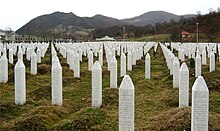
If a narrow definition of genocide is used, every bit favoured by the international courts, then during the Srebrenica massacre, viii,000 Bosnian Muslim men and boys were murdered and the residuum of the population (between 25,000 and thirty,000 Bosniak women, children and elderly people) was forced to leave the expanse. If a wider definition is used, and then the number is much larger. According to the ICTY Demographic Unit, an estimated 69.8% or 25,609 of the civilians killed in the war were Bosniak (with 42,501 military deaths), with the Bosnian Serbs suffering seven,480 civilian casualties (15,299 military machine deaths), the Bosnian Croats suffering one,675 civilian casualties (7,183 military machine deaths), amounting to a full of 104,732 casualties, spread betwixt the Bosnian Croats (8.5%), Bosnian Serbs (21.vii%), Bosniaks (65%), and others (four.8%).[79]
In January 2013, the Sarajevo-based Research and Documentation Centre (RDC) published its final results on "the most comprehensive" research into Bosnia-Herzegovina'southward war casualties: The Bosnian Book of the Dead – a database that reveals "a minimum of" 97,207 names of Bosnia and Herzegovina's citizens killed and missing during the 1992–1995 war. The caput of the ICTY Demographic Unit, Ewa Tabeu, has called it "the largest existing database on Bosnian state of war victims".[80] [81] More 240,000 pieces of data were collected, processed, checked, compared and evaluated by an international team of experts to tabulate the names of the victims. According to the RDC, 82% or 33,071 of the civilians killed in the war were Bosniak, with a minimum of 97,207 casualties, armed services and civilian, for all sides involved: Bosniaks (66.ii%), Serbs (25.four%) and Croats (7.8%), equally well as others (0.5%).[81] [82] [83]
George Szamuely'south Bombs for Peace estimates that the number of Muslims fleeing from Srebrenica to Tuzla in a mixed armed services-civilian column after the metropolis was abandoned by order of Bosnian commanders was maybe 12,000-15,000, and that of these equally few as i thousand or less died as they fought their way through Serb lines.[84]
In addition to those known to be outright killed; around 10,500[85] [86] people are notwithstanding missing with unknown fates due to the Bosnian State of war most of them Bosniaks.
In a statement on 23 September 2008 to the Un, Dr. Haris Silajdžić, every bit head of the Bosnia and herzegovina delegation to the Un 63rd Session of the General Assembly, said that "according to ICRC data, 200,000 people were killed, 12,000 of them children, upwards to l,000 women were raped, and 2.2 million were forced to abscond their homes. This was a veritable genocide and sociocide".[87] Nonetheless, such estimations have been criticized as highly inaccurate and analysts such as George Kenney have accused the Bosnian government and the international customs of sensationalism and of deliberately inflating the number of fatalities to attract international back up for the Muslims.[88]
Controversy and deprival
While the majority of international opinion accepts the findings of the international courts, in that location remains some disagreement about the extent of the genocide and to what degree Serbia was involved.
The Bosnian Muslim community asserts that the Srebrenica massacre was just one instance of what was a broader genocide committed by Serbia.[89]
The International Court of Justice veered away from the factual and legal findings of the ICTY Appeals Chamber in the Duško Tadić case. In the judgment delivered in July 1999, the Appeals Sleeping room plant that the Army of Republika Srpska was "nether overall command" of Belgrade and the Yugoslav Army, which meant that they had funded, equipped and assisted in the coordination and the planning of military operations. Had the International Court of Justice accustomed this finding of the Tribunal, Serbia would accept been constitute guilty of complicity in the Srebrenica genocide. Instead it concluded that the Appeals Chamber in the Tadic case "did not attempt to determine the responsibleness of a state but individual criminal responsibility". Paradoxical as information technology may be, the consequence of this legal suit filed back in March 1993 arrived too early for Bosnia and herzegovina. Radovan Karadžić arrest came over a year after the ICJ gave its judgement,[73] and Ratko Mladić, also defendant of genocide, was arrested in May 2011. Slobodan Milošević died during his trial and three trials of former Serb officials accept but started.[ when? ] [90]

Although the ICTY prosecutors had access to them during the trials, some of the minutes of wartime meetings of Yugoslavia's political and military leaders, were not fabricated public every bit the ICTY accepted the Serbian statement that to practice so would damage Serbia's national security. Although the ICJ could have subpoenaed the documents directly from Serbia, it did not do so and relied instead on those fabricated public during the ICTY trials. 2 of the ICJ judges criticised this decision in strongly worded dissents. Marlise Simons reporting on this in The New York Times, states that "When the documents were handed over [to the ICTY], the lawyers said, a team from Belgrade made it clear in letters to the tribunal and in meetings with prosecutors and judges that it wanted the documents expurgated to keep them from harming Serbia's case at the International Courtroom of Justice. The Serbs made no hush-hush of that even as they argued their case for 'national security,' said i of the lawyers, adding, 'The senior people here [at the ICTY] knew about this'.". Simons continues that Rosalyn Higgins the president of the ICJ, declined to comment when asked why the total records had not been subpoenaed, saying that "The ruling speaks for itself". Diane Orentlicher, a law professor at American University in Washington, commented "Why didn't the court request the full documents? The fact that they were blacked out clearly implies these passages would have fabricated a difference.", and William Schabas, a professor of international law at the University of Ireland in Galway, suggested that every bit a civil rather than a criminal courtroom, the ICJ was more used to relying on materials put earlier information technology than aggressively pursuing prove which might pb to a diplomatic incident.[92]
Deprival
Writers, including Edward S. Herman, believe that the Srebrenica massacre was not genocide. They cite that women and children were largely spared and that only military historic period men were targeted.[93] [94] This view is not supported by the findings of the ICJ or the ICTY.[95]
Co-ordinate to Sonja Biserko, president of the Helsinki Committee for Man Rights in Serbia, and Edina Bećirević, the faculty of criminology and security studies of the Academy of Sarajevo:
Deprival of the Srebrenica genocide takes many forms in Serbia. The methods range from the vicious to the deceitful. Deprival is nowadays well-nigh strongly in political discourse, in the media, in the sphere of law, and in the educational system.[96]
See also
- Srebrenica massacre
- Bosniaks
- Command responsibility
- Genocides in history
- Republika Srpska
- Serbian war crimes in the Yugoslav Wars
Footnotes
- ^ To date, but the massacre in Srebrenica[two] has been described every bit a offense of genocide by the ICTY. Overall, 34,000 Bosniak civilians were killed during the war and ane.two million forcibly removed[3] from a minimum of 64,036 Bosniak fatalities overall.[4]
References
- ^ "Bosnia'due south Srebrenica massacre 25 years on - in pictures". BBC News . Retrieved 5 March 2022.
- ^ a b c Mojzes, Paul (2011). Balkan Genocides: Holocaust and Ethnic Cleansing in the Twentieth Century. Rowman & Littlefield. p. 178. ISBN978-1-4422-0663-2.
- ^ Peterson, Roger D. (2011). Western Intervention in the Balkans: The Strategic Utilise of Emotion in Disharmonize. Cambridge University Press. p. 121. ISBN978-1-139-50330-3.
- ^ Toal, Gerard (2011). Bosnia Remade: Ethnic Cleansing and Its Reversal. Oxford University Press. p. 136. ISBN978-0-19-973036-0.
- ^ "Serbia: Mladic "Recruited" Infamous Scorpions". Found for War and Peace Reporting. [1]
- ^ A Witness to Genocide: The 1993 Pulitzer Prize-Winning Dispatches on the "Ethnic Cleansing" of Bosnia, Roy Gutman
- ^ John Richard Thackrah (2008). The Routledge companion to armed services conflict since 1945, Routledge Companions Series, Taylor & Francis, 2008, ISBN 0-415-36354-3, ISBN 978-0-415-36354-9. pp. 81–82: "Bosnian genocide tin can hateful either the genocide committed past the Serb forces in Srebrenica in 1995 or the indigenous cleansing during the 1992–95 Bosnian War"
- ^ ICTY; "Address by ICTY President Theodor Meron, at Potocari Memorial Cemetery" The Hague, 23 June 2004 ICTY.org
- ^ ICTY; "Krstic judgement" UNHCR.org Archived 18 October 2012 at the Wayback Machine
- ^ ICTY; "Karadzic indictment. Paragraph 19" ICTY.org
- ^ Jorgic v. Deutschland (Judgment), ECHR (12 July 2007). §§ 36, 47, 111.
- ^ Jorgic five. Germany (Judgment), ECHR (12 July 2007). §§ 47, 107, 108.
- ^ A resolution expressing the sense of the Senate regarding the massacre at Srebrenica in July 1995, 109th Congress (2005–2006), [S.RES.134]. Archived on 7 January 2016.
- ^ Jorgic v. Germany (Judgment), ECHR (12 July 2007). §§ 47, 112.
- ^ Simons, Marlise (20 March 2019). "Radovan Karadzic Sentenced to Life for Bosnian War Crimes". The New York Times . Retrieved 26 Apr 2020.
- ^ "Radovan Karadžić to serve residual of sentence in British prison". The Guardian. Reuters. 12 May 2021. Retrieved 20 Feb 2022.
- ^ "Everyday objects, tragic histories". TED Talks. March 2014. Retrieved 27 August 2014. , Ziyah Gafić, four:32
- ^ Jorgic five. Germany (Judgment), ECHR (12 July 2007), § 45, citing Bosnia and Herzegovina v. Serbia and Montenegro § 190 ("Case concerning the application of the Convention on the Prevention and Punishment of the Criminal offence of Genocide"): the International Courtroom of Justice (ICJ) constitute under the heading of "intent and 'ethnic cleansing'."
- ^ Un General Assembly Session 47 Resolution 121. The situation in Bosnia and herzegovina: resolution / adopted by the General Assembly A/RES/47/121 18 December 1992. Retrieved xi July 2020.
- ^ Jorgic v. Deutschland (Judgment), ECHR (12 July 2007). § 112.
- ^ The International Criminal Tribunal for the Former Yugoslavia found in Prosecutor v. Radislav Krstic – Trial Bedchamber I – Judgment – IT-98-33 (2001) ICTY8 (2 Baronial 2001) that genocide had been committed. (see paragraph 560 for name of group in English on whom the genocide was committed). Information technology was upheld in Prosecutor v. Radislav Krstic – Appeals Sleeping accommodation – Judgment – It-98-33 (2004) ICTY vii (xix Apr 2004)
- ^ ICTY "Prosecutor v. Krstic" Archived 26 March 2009 at the Wayback Machine
- ^ ICTY; "Address by ICTY President Theodor Meron, at Potocari Memorial Cemetery" The Hague, 23 June 2004 UN.org Archived three April 2009 at the Wayback Auto
- ^ Staff. Momcilo Krajisnik bedevilled of crimes against humanity, acquitted of genocide and complicity in genocide, A press release by the ICTY in The Hague, 27 September 2006 JP/MOW/1115e
- ^ "Archived re-create". Archived from the original on 9 July 2015. Retrieved 20 July 2015.
{{cite web}}: CS1 maint: archived copy as title (link) - ^ Irwin, Rachel. 13 December 2012. "Genocide Conviction for Serb Full general Tolimir Archived 8 March 2013 at the Wayback Motorcar." Global Voices: Europe & Eurasia (769). UK: Found for War and Peace Reporting.
- ^ "Appeals Chamber upholds Tolimir's convictions for genocide and unanimously upholds life sentence | International Criminal Tribunal for the former Yugoslavia". www.icty.org . Retrieved 26 January 2021.
- ^ "Decision on Movement to Enter Judgment of Acquittal" (PDF). United nations, International Criminal Tribunal for the former Yugoslavia. 16 June 2004. Retrieved 30 November 2020.
- ^ Paul Mitchell (16 March 2007). "The significance of the Globe Courtroom ruling on genocide in Bosnia". World Socialist Spider web. Retrieved ix February 2013.
- ^ Schultz, Teri (22 November 2017). "'Butcher of Bosnia' Ratko Mladic Guilty of Genocide, Crimes Against Humanity". NPR.org . Retrieved 4 December 2020.
- ^ International Criminal Tribunal for the Former Yugoslavia, ICTY. "Karadzic Acquitted of One Genocide Accuse". ICTY. Retrieved 28 June 2012.
- ^ International Criminal Tribunal for the Onetime Yugoslavia, ICTY. "Appeals Sleeping accommodation reverses Radovan Karadžić'southward acquittal for genocide in municipalities of Bosnia and Herzegovina". ICTY. Retrieved eleven July 2013.
- ^ Prosecutor's Marked-up Indictment, ICTY Instance No. IT-95-5/18-PT THE PROSECUTOR v RADOVAN KARADZIC, 19 Oct 2009. Retrieved 7 June 2011
- ^ Prosecutor's Marked-upward Indictment, ICTY Case No. Information technology-09-92-I THE PROSECUTOR v RATKO MLADIC, 1 June 2011. Retrieved 7 June 2011
- ^ "Court clears Serbia of genocide". BBC News. 26 February 2007.
- ^ "The ICTY Judgement in the Prosecutor vs. Momcilo Perisic case" (PDF). ICTY.
- ^ Hoare, Dr. Marko Attila (5 March 2013). "Why was Momcilo Perisic acquitted ?".
- ^ Simons, Marlise (30 May 2013). "UN Courtroom Acquits 2 Serbs of War Crimes". The New York Times.
- ^ "Expressing the sense of the House of Representatives regarding the massacre at Srebrenica in July 1995". Archived from the original on 20 October 2008. Retrieved 31 January 2008.
- ^ Washington Post. "Votes Database: Neb: H RES 199 Archived half-dozen March 2016 at the Wayback Machine" 27 June 2005
- ^ Markup Committee on International Relations House of Representatives (pdf) Archived 31 Jan 2008 at the Wayback Machine, 109th Congress, H. Res. 199 and H.R. 2601, 26 May 2005, Serial No. 109–87. p. 13
- ^ Smith, Gordon (22 June 2005). "S.Res.134 - A resolution expressing the sense of the Senate regarding the massacre at Srebrenica in July 1995". Congress.gov . Retrieved 20 Apr 2017.
- ^ Christopher Smith H.Res. 199, Expressing the Sense of the Firm of Representatives Regarding the Massacre at Srebrenica in July 1995. Retrieved 31 January 2008
- ^ CRS Summary: A resolution expressing the sense of the Senate regarding the massacre at Srebrenica in July 1995
- ^ a b Max, Arthur (26 February 2007). "Courtroom: Serbia Failed to Forestall Genocide". San Francisco Relate. Archived from the original on 10 August 2007. Retrieved 13 March 2021.
- ^ "Sense Tribunal: Serbia establish guilty of failure to forbid and punish genocide". Archived from the original on 30 July 2009.
- ^ ICJ: Bosnian Genocide Example: Summary of the Judgment of 26 Feb 2007 [ii] Archived 5 June 2011 at the Wayback Automobile
- ^ ICJ press release 2007/viii Archived 13 February 2010 at the Wayback Car 26 February 2007
- ^ Shany, Yuval (Leap 2008). "Bosnia, Serbia and the politics of international adjudication" (PDF). Justice. International Association of Jewish Lawyers and Jurists (45): 21–26. Retrieved 13 March 2021.
- ^ A judicial massacre, The Guardian, 27 February 2007. https://www.theguardian.com/commentisfree/2007/feb/27/thejudicialmassacreofsrebr
- ^ Dissenting stance of Judge Al-Khasawneh, Vice-President of the International Court of Justice, "Archived copy" (PDF). Archived from the original (PDF) on 29 June 2011. Retrieved 24 May 2011.
{{cite web}}: CS1 maint: archived re-create as title (link) - ^ KBSA 2000, Interview with Sir Geofrey Nice, "The Victims of Srebrenica, Living and Dead, Deserve Truth" Archived 9 March 2012 at the Wayback Car [scroll down the page for English version]
- ^ Federal High Courtroom of Germany: Translation of Press Release into English Nr. 39 on xxx April 1999: Federal High Court makes basic ruling on genocide, Foreclose Genocide International
- ^ ECHR – Jorgić 5. Germany Judgment, 12 July 2007. § xviii,98,99
- ^ ECHR Jorgić v. Germany Judgment, 12 July 2007. § 36 just besides §§ 18,47,99,103,108
- ^ See also "'Indigenous Cleansing' and Genocidal Intent: A Failure of Judicial Estimation?", Genocide Studies and Prevention 5, 1 (Apr 2010), Douglas Singleterry
- ^ ECHR Jorgić 5. Frg Judgment, 12 July 2007. § 42 citing Prosecutor v. Krstić, IT-98-33-T, judgment of 2 Baronial 2001, §§ 580
- ^ ECHR Jorgić 5. Germany Judgment, 12 July 2007. § 43 citing the judgment of 19 April 2004 rendered by the Appeals Chamber of the ICTY, IT-98-33-A §§ 25,33
- ^ ECHR Jorgić v. Federal republic of germany Judgment, 12 July 2007. § 44 citing Prosecutor v. Kupreškić and Others (It-95-16-T, judgment of fourteen January 2000), § 751
- ^ ECHR Jorgić v. Germany Judgment, 12 July 2007. §45 citing Bosnia and Herzegovina 5. Serbia and Montenegro ("Instance apropos the awarding of the Convention on the Prevention and Punishment of the Law-breaking of Genocide") the International Court of Justice (ICJ) establish under the heading of "intent and 'indigenous cleansing'" § 190
- ^ European Courtroom of Human Rights Archived nine May 2013 at the Wayback Machine – |%20%27ethnic%20|%20cleansing%27&sessionid=24809174&peel=hudoc-en Jorgić v. Germany Judgment [ dead link ] , 12 July 2007. § 47
- ^ ECHR Jorgić 5. Deutschland Judgment, 12 July 2007. § 105
- ^ ECHR Jorgić v. Federal republic of germany Judgment, 12 July 2007. § 113
- ^ ECHR Jorgić v. Frg Judgment, 12 July 2007. § 116
- ^ European Parliament resolution of fifteen Jan 2009 on Srebrenica, P6_TA(2009)0028 European Parliament – fifteen January 2009.
- ^ Mladić Trial Chamber Sentence 2017, p. 2266
- ^ Staff. War crimes example widens 'genocide', BBC, nineteen April 2004
- ^ Staff, Life for Bosnian Serbs over genocide at Srebrenica, BBC, 10 June 2010
- ^ Aida Cerkez-Robinson (xxx July 2008). "7 Bosnian Serbs guilty of genocide in Srebrenica". USA Today. Archived from the original on 17 Feb 2016.
- ^ Staff. Bosnian Serbs jailed for genocide, BBC, 29 July 2008
- ^ Staff. Bosnian Serb jailed for genocide, BBC, 16 October 2009
- ^ Case No. IT-02-54-T: The Prosecutor of the Tribunal against Slobodan Milosevic, amended indictment, ICTY, 22 November 2002
- ^ a b Staff. Karadzic flown to Hague tribunal, BBC, xxx July 2008
- ^ Ratko Mladic arrested: Bosnia war crimes suspect held, BBC, 26 May 2011
- ^ "Radovan Karadzic sentenced to 40-twelvemonth imprisonment for Srebrenica genocide, war crimes". The Hindu. 24 March 2016.
- ^ "UN hails conviction of Mladic, the 'epitome of evil,' a momentous victory for justice". UN News Eye. 22 November 2017. Retrieved 23 November 2017.
- ^ Owen Bowcott, Julian Borger (22 November 2017). "Ratko Mladić bedevilled of war crimes and genocide at United nations tribunal". The Guardian. Outcome occurs at 11:00. Retrieved 23 November 2017.
- ^ "'Butcher of Bosnia' Mladic's appeal verdict gear up for June". French republic 24. 30 April 2021. Retrieved 20 May 2021.
- ^ "THE 1992–95 WAR IN BOSNIA AND HERZEGOVINA: CENSUS-BASED MULTIPLE Organisation Estimation OF CASUALTIES' UNDERCOUNT" (PDF). ICTY. Retrieved 27 January 2013.
- ^ "Bosnia war expressionless figure announced". BBC News. 21 June 2007.
- ^ a b Research and Documentation Center: Rezultati istraživanja "Ljudski gubici '91–'95" Archived 3 December 2010 at the Wayback Automobile
- ^ Lara J. Nettelfield (2010). Courtship Republic in Bosnia and herzegovina. Cambridge University Press. ISBN9780521763806 . Retrieved 22 July 2013. , pp. 96–98
- ^ "After years of toil, volume names Bosnian war dead". Reuters. 15 February 2013. Archived from the original on 21 July 2013. Retrieved 30 June 2017.
- ^ Szamuely, George, Bombs for Peace, 2013, Amsterdam, Amsterdam University Press, pp. 314-323
- ^ "Balkans: Thousands still missing 2 decades after conflicts". Amnesty International. 30 August 2012. Archived from the original on 2 August 2014. Retrieved 17 May 2015.
- ^ ICRC Annual Report 2010 Archived 15 May 2012 at the Wayback Machine, icrc.org; accessed 25 May 2015, p. 345
- ^ Statement by Dr. Haris Silajdžić, Chairman of the Presidency Bosnia and herzegovina, Head of the Delegation of Republic of bosnia and herzegovina at the 63rd Session of the General Associates on the occasion of the General Debate, Summary, 23 September 2008.
- ^ George Kenney (23 April 1995). "The Bosnian adding". The New York Times . Retrieved 7 October 2012.
- ^ van den Biesen."Application of the Convention on the Prevention and Punishment of the Crime of Genocide, General Concluding Ascertainment". International Courtroom of Justice. 24 April 2006, para. 1–12. ICJ-CIJ.org Archived nine July 2006 at the Wayback Machine
- ^ Sense Tribunal: ICTY – The missing link Archived 22 December 2008 at the Wayback Machine
- ^ Decision of the ICTY Appeals Sleeping room; 18 April 2002; Reasons for the Determination on Prosecution Interlocutory Entreatment from Refusal to Order Joinder; Paragraph eight
- ^ Marlise Simons. Genocide Courtroom Ruled for Serbia Without Seeing Full War Archive, The New York Times, nine April 2007
- ^ The Politics of the Srebrenica Massacre, Z Internet, 7 July 2007, by Edward S. Herman, zmag.org Archived one July 2009 at the Portuguese Web Archive
- ^ "The existent story behind Srebrenica", The Earth and Mail, 14 July 2005.
- ^ ICTY, Prosecutor vs Krstic, Trial Bedchamber Judgement, Case No. Information technology-98-33-T, paras 43–46. United nations.org Archived one April 2009 at the Wayback Machine
- ^ Denial of genocide – on the possibility of normalising relations in the region Archived 3 March 2016 at the Wayback Motorcar by Sonja Biserko (the Helsinki Committee for Human Rights in Serbia) and Edina Becirevic (faculty of criminology and security studies of the University of Sarajevo).
Other sources
- Max Bergholz. Violence as a Generative Force: Identity, Nationalism, and Memory in a Balkan Community. Ithac, Cornell Academy Press, 2016. 464 pp. $35.00 (cloth), ISBN 978-1-5017-0492-5.
- Genocide in Bosnia-Herzegovina: Hearing before the Committee on Security and Cooperation in Europe,United States, 1995.ISBN 9780160474446.
- Paul R. Bartrop, Bosnian Genocide: The Essential Reference Guide,Greenwood Press, 2016.ISBN 9781440838682.
- Walasek Helen, Bosnia and the destruction of cultural heritage, Routledge, 2015. ISBN 1409437043.
- Donia Robert. J, Radovan Karadžić : Architect of the Bosnian Genocide, Cambridge University Printing, 2014, ISBN 1107073359.
- Roy Gutman, A witness to genocide, Prentice Hall & IBD, 1993, ISBN 0-02-546750-6.
- Cigar, Norman, Genocide in Bosnia: The Policy of "Ethnic Cleansing", 1995, Texas A & Thousand University Printing, 1995.ISBN 0890966389.
- Allen, Beverly, Rape Warfare: The Hidden Genocide in Bosnia-Herzegovina and Croatia. Minneapolis: University of Minnesota Press,1996. ISBN 0816628181.
- Ching Jackie, Genocide and the Bosnian War, Rosen Publishing Group, 2008. ISBN 9781404218260.
- Edina Bećirević, Genocide on the Drina River, New Haven and London: Yale University Press, 2014, ISBN 978-0-300-19258-2.
- Michael Anthony Sells, The Bridge Betrayed: Religion and Genocide in Bosnia, Berkeley: University of California Printing, 1998, ISBN 978-0520206908.
- Attila Hoare Marko, Bosnia and herzegovina: Genocide, Justice and Denial, Middle for Advances Studies, 2015, ISBN 978-9958022128.*
- Thomas Cushman and Stjepan Mestrovic, This Time We Knew: Western Reponses to Genocide in Bosnia, New York Academy Press, 1996, ISBN 978-0814715352.
- "Prosecutor v. Ratko Mladić" (PDF). The Hague: International Criminal tribunal for the Erstwhile Yugoslavia. 22 November 2017.
Further reading
- Ed Vulliamy, The War Is Dead, Long Live the War: Bosnia: The Reckoning, Bodley Caput (London, 19 Apr 2012) ISBN 978-one-84792-194-9. Focusses on the camps.
External links
- America and the Bosnia Genocide past Marker Danner New York Review of Books, Volume 44, Number 19, 4 December 1997
- Bosnia Genocide Studies Program, at Yale University → latest archived on 7 July 2019
- Aegis Trust (genocide prevention trust) An contained international organisation dedicated to eliminating genocide
- Srebrenica – a 'Safe haven' Netherlands Institute for War Documentation, Srebrenica – a 'Condom haven', an extensive Dutch government study on events in eastern Bosnia and the fall of Srebrenica.
- Bosnia victims entreatment Karadzic'south Genocide Acquittal from Balkan Insight
- Leydesdorff, Selma. Surviving the Bosnian Genocide: The Women of Srebrenica Speak. Trans. Kay Richardson. Bloomington: Indiana Academy Press, 2011.
- Missing No Longer – International commission forges alee to place genocide victims, Scientific American, 1 Baronial 2006
- Genocide-Bosnia at Peace Pledge Union Information website
- A review of the film Storm, by manager Hans-Christian Schmid (Screen Comment)
Source: https://en.wikipedia.org/wiki/Bosnian_genocide
0 Response to "What Was the Reaction to the Bosnian Genocide by the Outside World While It Was Occurring"
ارسال یک نظر